Fire, Rice, and the Threshold: A Yagya Before Birth
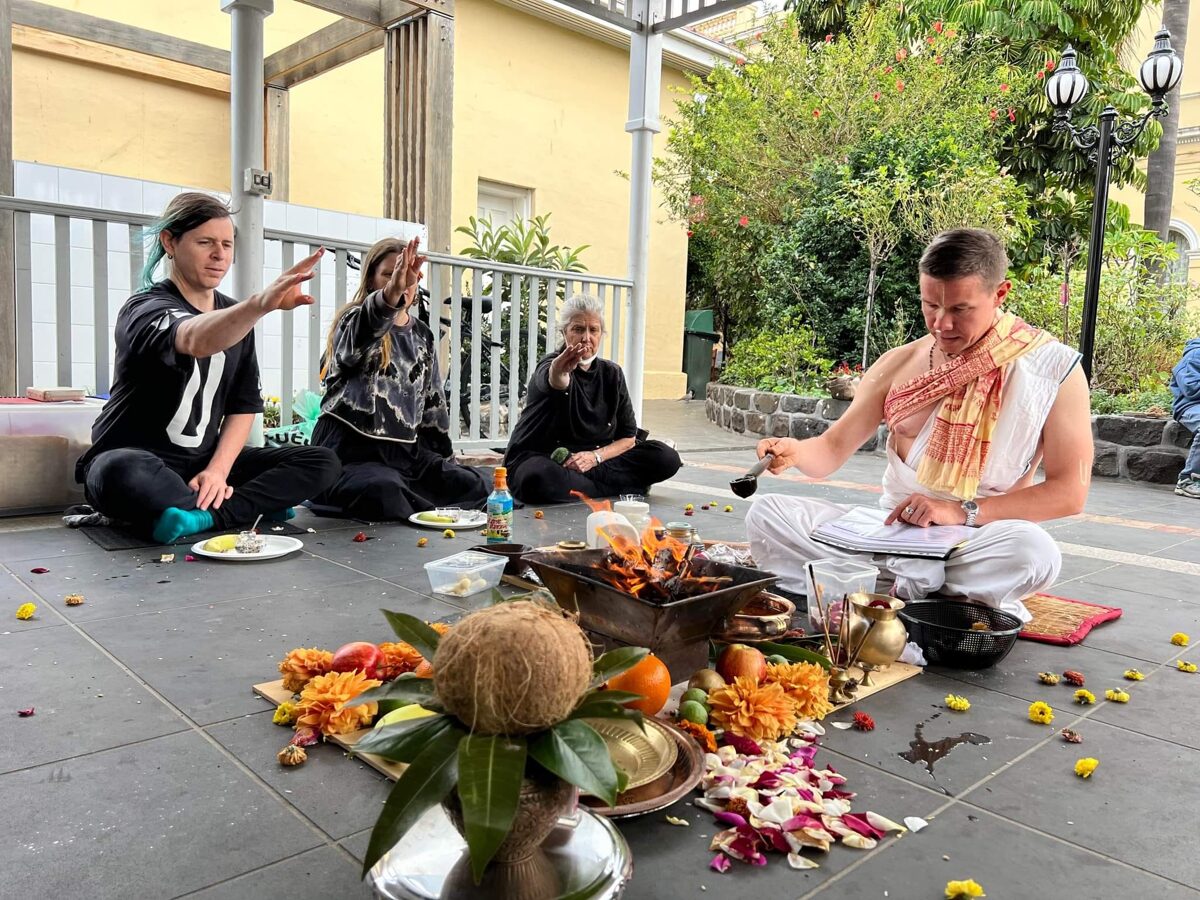
Ghee and rice, cast into the flame, a smell of ancient tradition. Four women sat cross-legged on the ground opposite us in the yard of the ISKCON temple in Albert Park, their hands moving with the unhurried confidence of people who have done this before. A brahmin sat in the middle and read from a sacred text in a low, steady voice. Around the fire, a simple flower mandala with fruit offerings marked the centre. My friend sat beside me, also pregnant. We repeated the Sanskrit words we were given to and threw rice into the flames when the brahmin indicated. Later, when the singers arrived, we chanted Hare Krishna together. I am not a Hare Krishna devotee. My mother is, and she arranged this ritual for me.
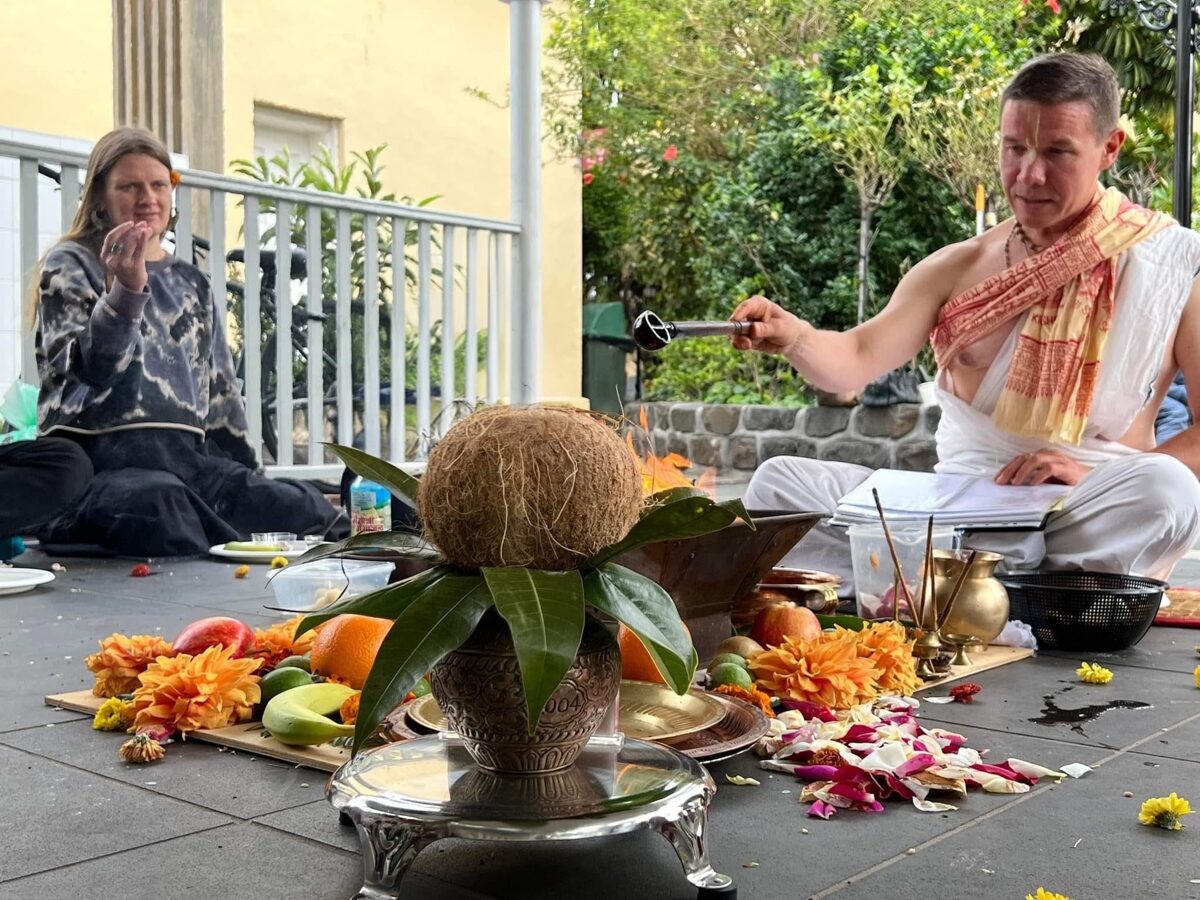
The ritual is called Yagya, performed to bless and cleanse the unborn soul to help a child arrive from a more auspicious place in the universe. Four years ago, I was pregnant with my first child. Moving from maiden to mother is, for many cultures, among the most significant ‘rites de passage’ for a woman (Turner 1967:93). So, it was for me. One becomes temporarily unrecognisable to oneself. A woman is separated from her former identity, but has not yet been reincorporated into the new one, a form of ambiguity, what van Gennep's original formulation, betwixt and between (Turner 1967: 94). The identity of her previous self no longer fully applies, but the new one, as a mother, a parent, a transformed person has not yet been granted.
Pregnancy makes this ambiguity brutally literal. I was, in the literal physical sense, two bodies sharing one. I was no longer simply myself, and not yet a mother. The Yagya did not attempt to resolve this contradiction. Instead, it honoured it. It gathered witnesses around the uncertainty and treated the threshold itself as sacred. My pregnant friend sitting beside me at the fire was not incidental. We were two liminal bodies sharing the same suspended state, and something real passed between us in that circle that ordinary social life does not easily produce. We were both waiting for the same kind of transformation.
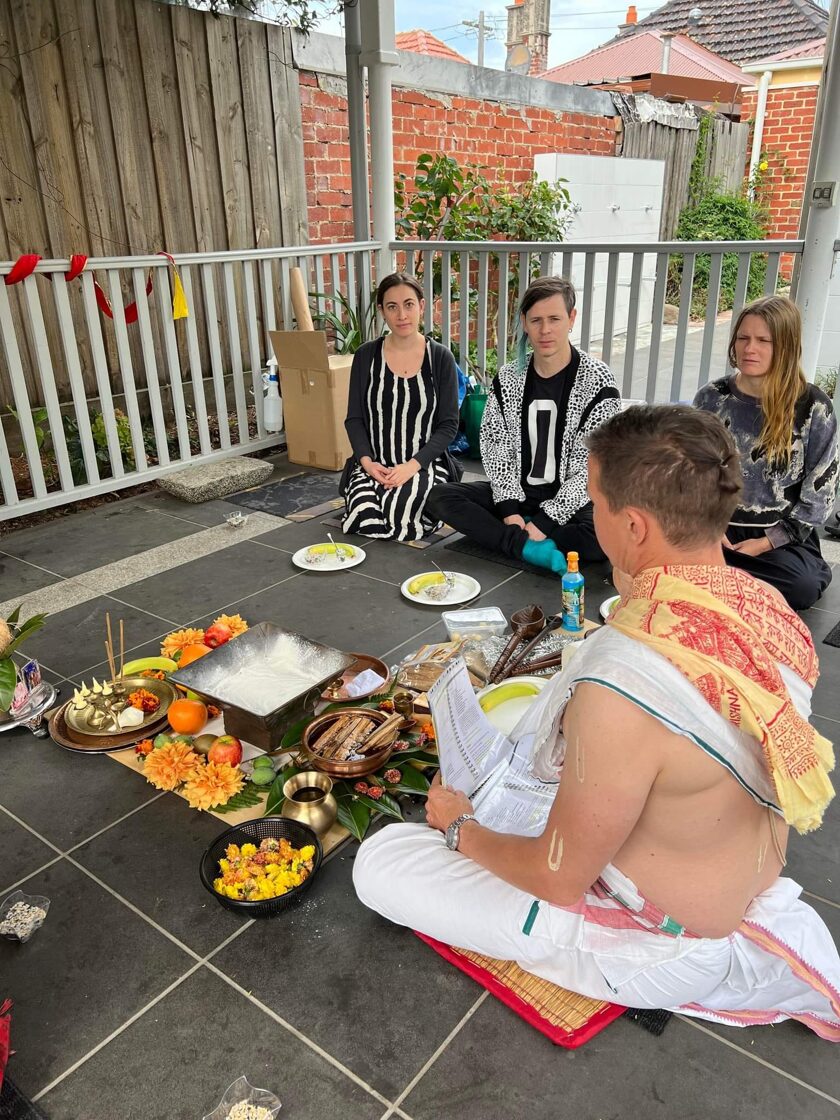
Turner describes how liminal figures are often stripped of their former identity and held in a kind of creative suspension before re-incorporation into the social world in a new form (Turner 1967: 96). The fire, the repetition of sacred words, and the act of offering created a bounded, set-apart time. We were outside of the ordinary world of a hospital, brochures, put-together ‘becoming a parent’ Zoom e-room. We were in a third space, where the unborn soul could be addressed directly.
Birth itself is the threshold moment, where a woman is so open to the vast cosmic void. On one side: a maiden who has not yet given birth. On the other: a mother, a different creature entirely. And the passage between them is irreversible. The Yagya was positioned deliberately before this crossing, in the deepest part of the liminal phase, when the child is still unborn, and the future is still veiled. This is the ritual's timing, and it matters. Rituals, Turner argues, do not merely mark transitions; they actively participate in shaping them (Turner 1967: 97).
But who assembled this ritual, and from what? I am not a devotee. My friend was not either. The brahmin belonged to a tradition neither of us fully shares. The temple was a borrowed space for us. The rice and ghee were materials at hand.
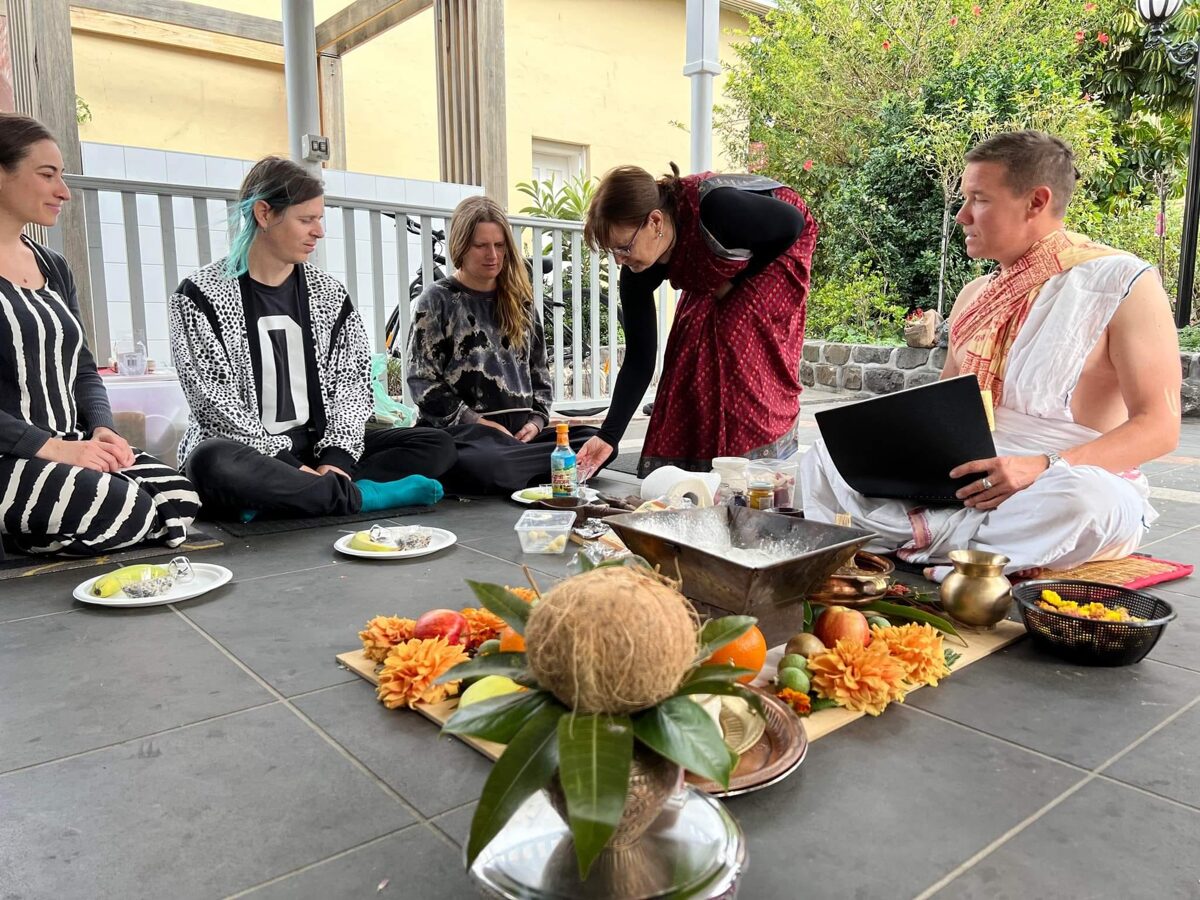
Claude Lévi-Strauss describes the bricoleur as someone who works with whatever is available, assembling meaning and function from the resources existing in the present moment, rather than from purpose-built materials (Lévi-Strauss 1962: 11). The bricoleur does not design from emptiness; she gathers what is near, and reorganises it toward a new purpose. My mother was a bricoleur. She took her faith, her network, the Melbourne ISKCON community, a brahmin willing to perform the ceremony, and she assembled a Yagya from the pieces available to her. The result was not any single tradition in its pure form but rather something living, improvised, and deeply human. Lévi-Strauss argues that meaning has always been made this way: myths, rituals, and symbolic systems are continually reconstructed from an inherited reservoir of fragments and signs (Lévi-Strauss 1962: 11). We inherit remnants and attempt, as gracefully as possible, to make coherence from them.
What is striking is that the assembled nature of the ritual did not weaken its force. I trusted in the brahmin's competence, in the form itself, in my mother's care with which she had arranged the entire event. Her devotion held the disparate pieces together. The ritual worked not because it was untouched by adaptation, but because it was sustained by genuine intention.
This brings me to Heidegger. In his essay The Question Concerning Technology, Heidegger distinguishes two modes of revealing the world. The first he calls ‘challenging-forth’: the logic of modern technology, in which the world is ordered, extracted, managed, and made available for use (Waddington 2005: 569). Under this logic, the forest becomes a timber reserve, the river becomes hydroelectric potential, and the body becomes a site of optimisation.
Pregnancy under modern medical culture often unfolds through precisely this mode of revealing. The unborn child appears first as measurements: percentile, heartbeat, estimated weight, and risk category. Before meeting the child, one meets the data. Birth itself becomes monitored, scheduled, induced, accelerated, and managed beneath fluorescent lighting and institutional timelines. I do not say this to condemn medical technology. Modern obstetrics saves lives. But Heidegger’s distinction helps illuminate what the Yagya was doing differently.
Nothing around that fire attempted mastery. We sat cross-legged in the smoke, throwing rice into flame, performing gestures whose outcomes could not be guaranteed. It was an act of offering rather than control. And perhaps the difference between offering and controlling is exactly the distinction Heidegger is trying to name.
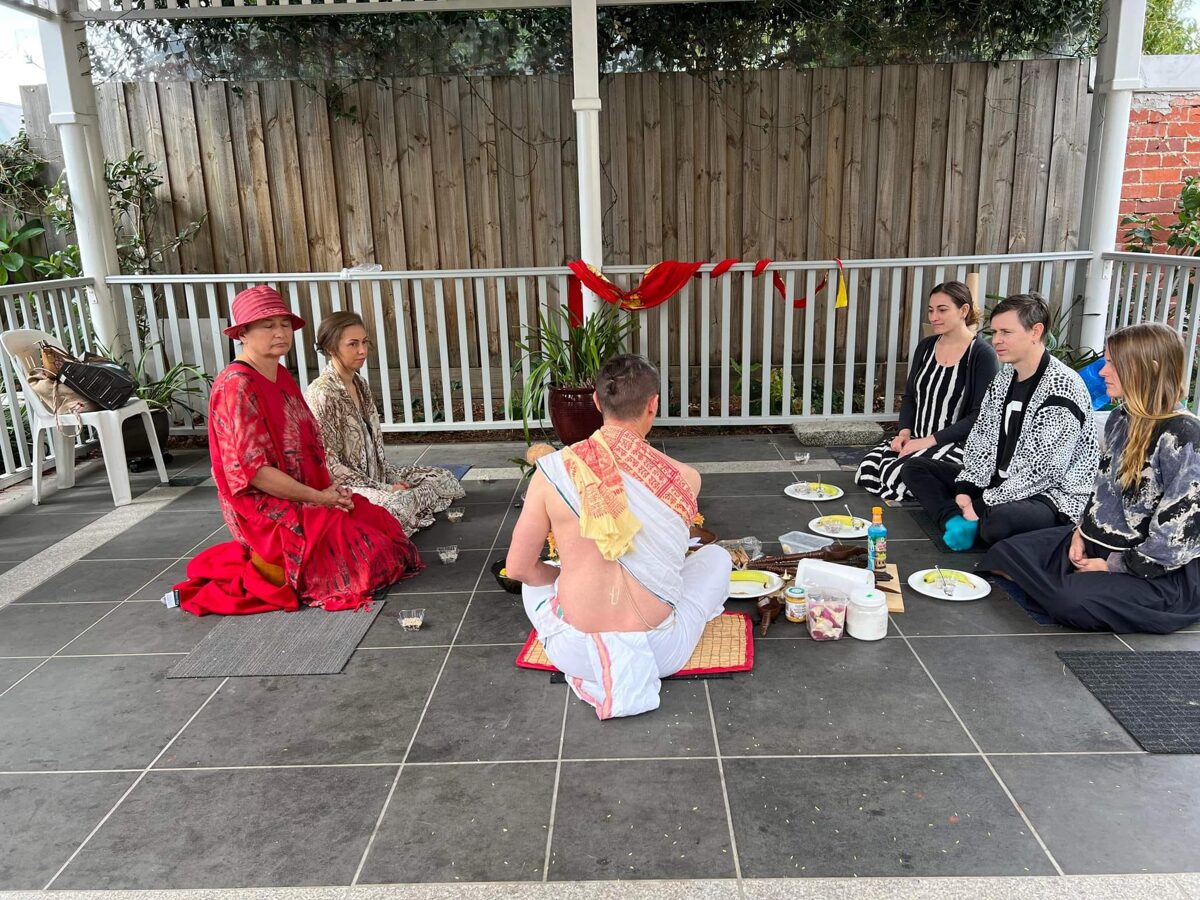
Offering requires a certain surrender. It acknowledges that something exceeds your command and chooses devotion instead of domination. The fire received what we gave it. The brahmin opened a channel we ourselves could not open. We repeated words whose full meanings remained partially inaccessible to us. None of this belonged to the logic of ‘challenging-forth’. It was, in Heidegger’s sense, a form of ‘bringing-forth’: a careful calling toward presence rather than an imposition upon it (Waddington, 568–569).
When I left the temple that afternoon, I carried away something difficult to describe in rational terms. The diffuse anxiety of pregnancy a strange sensation of standing at the edge of an irreversible life. The threshold had been acknowledged publicly rather than endured privately. The ritual had not erased uncertainty, but it had reorganised it into something bearable.
Still, Baudrillard would likely ask an uncomfortable question of the entire event. His theory of the simulacrum describes a world in which copies have substituted originals so thoroughly that the original can no longer be located (Baudrillard 1994: 2). Contemporary birth culture is dense with this kind of simulation: gender reveals, curated hospital photographs, birth plans written in the language of consumer preference. These rituals often represent birth while simultaneously insulating participants from its terror, unpredictability, and metaphysical strangeness.
The Yagya was attempting something different: a direct encounter with the sacred threshold itself. Yet perhaps the ritual was already a simulacrum too. My Russian mother transplanted a tradition from one continent to a Melbourne suburb. The ISKCON temple is itself a copy of something that originated far away and long ago. Baudrillard might suggest that what we performed beside that fire was a simulation of a simulation, a sign referring to other signs, with no stable original beneath them (Baudrillard 1994: 6).
And yet. Lévi-Strauss offers a quieter answer. The bricoleur never possessed access to a pure original. No human ritual emerges untouched by migration, borrowing, reinterpretation, or historical layering. Traditions survive precisely because they are rearranged and carried forward by imperfect people in imperfect circumstances. Authenticity may therefore be the wrong question entirely.
What matters is whether the assembled pieces produce genuine transformation. In my case, I felt the touch of the divine and a connection to my child`s soul. In the vast cosmos of my reality, I sat presently with what was and allowed the fire, the smoke, the chanting to assist in transformation. The restructuring was real. The offering was real. And in the trembling uncertainty of becoming a mother, the fire carried it forward.

References
Baudrillard J (1994) ‘Simulacra and simulation’, University of Michigan Press, Michigan. [1981]. Accessed 23 May 2026
Lévi-Strauss C (1962) ‘The Savage Mind’, Sixth impression, University of Chicago Press. Accessed 23 May 2026
Turner V (1967) ‘The forest of
symbols: Aspects of Ndembu ritual’, Cornell
University
Press, The United States.
Accessed 22 May 2026
Waddington DI (2005) ‘A field guide to Heidegger: Understanding ‘The Question Concerning Technology’, Educational Philosophy & Theory, 37(4), pp 567-583. doi:10.1111/j.1469-5812.2005.00141.x. Accessed 24 May 2026